
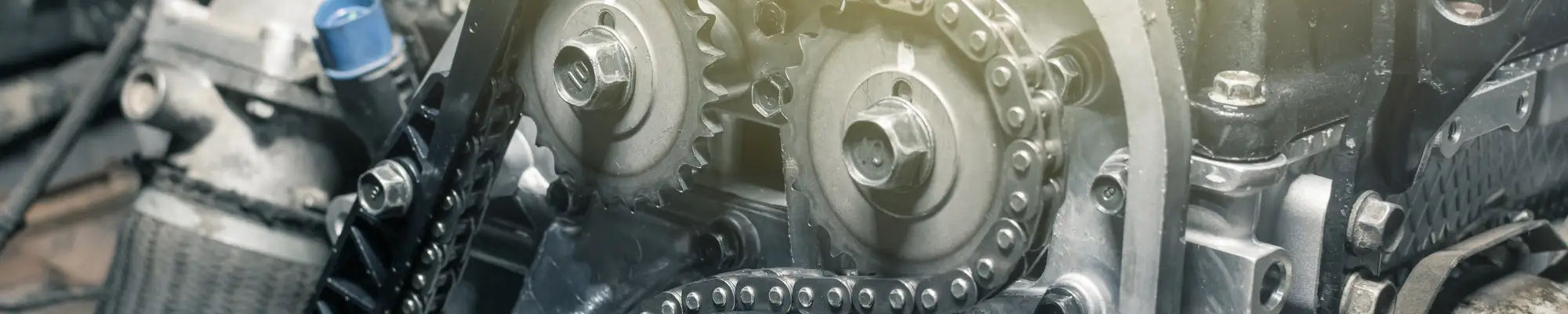
Timing Belt & Chain Replacement In Nottingham
A failed timing belt or chain can stop your engine instantly and cause serious damage, which makes replacing it on time one of the most important jobs your car will ever need.
We replace cambelts and timing chains for drivers across Nottingham at our garage in Stapleford.
What Your Timing Belt Does
Your timing belt or chain links the crankshaft to the camshafts, keeping the pistons and valves moving in perfect time. Every rotation of the engine depends on that synchronisation being exact.
Timing belts are made from reinforced rubber, which stretches, hardens and cracks with age and mileage. Because the belt sits behind covers, wear is rarely visible, and many belts give no warning at all before they break.
Replacing a belt at the right interval costs a fraction of the repair bill that follows a failure.
When To Replace Your Timing Belt / Chain
- You’ve reached the replacement interval in your handbook. Belts have both a mileage and an age limit, and should be changed at whichever comes first.
- You’ve bought a used car with no proof of a recent change, in which case replacing the belt is the safest option.
- There’s a rhythmic ticking or slapping from the front of the engine, which can come from a worn belt or loose chain.
- The engine rattles for a few seconds after a cold start, a common sign of a stretched timing chain.
- You can hear squealing or whining, especially on start-up, which can point to a failing tensioner or idler pulley.
- The engine management light has come on. A stretched chain can trigger timing related fault codes.
- The engine misfires, runs unevenly or struggles to start, which can happen if the timing has slipped.
How We Replace Timing Belts / Chains
- We confirm whether your engine uses a belt or a chain, and follow the manufacturer’s procedure for your car.
- We remove covers, ancillary belts and other components to reach the timing system.
- Locking tools hold the crankshaft and camshafts in exactly the right position.
- We replace the belt or chain along with its tensioner, guides or pulleys, plus the water pump where required.
- We set the tension to specification and turn the engine by hand to confirm the timing is correct.
- Everything is refitted, then we start the engine and check that it runs smoothly.
If other work is due (such as an auxiliary belt) a coolant change or an oil leak repair, it’s often worth doing at the same time, as much of the labour overlaps.
Belt Or Chain: What’s The Difference?
Both systems do the same job, but they wear differently and need different care.
Timing Belts
Timing belts are toothed rubber belts that run quietly and keep engines light and compact. Manufacturers set replacement intervals that commonly range from 40,000 to 100,000 miles, along with an age limit of several years.
Timing Chains
Timing chains are made of metal and run inside the engine, lubricated by the engine oil. They’re designed to last much longer than belts, but they can stretch over time, particularly if oil changes have been missed.
Wet Belts
Some modern engines, including Ford’s 1.0 EcoBoost and the 1.2 PureTech used by Peugeot, Citroën and Vauxhall, have a belt that runs in engine oil. These wet belts can degrade if the wrong oil is used or services are skipped, and debris from a worn belt can block the oil supply.
What Happens When A Belt Fails
In many engines, the valves and pistons occupy the same space at different moments. These are known as interference engines. If the belt or chain fails, the pistons can strike open valves, causing bent valves, damaged pistons and, in some cases, a ruined engine.
Why Costs Vary Between Engines
Labour makes the biggest difference, as access varies hugely from one engine to another, and some need the engine supported or partly lowered. Timing chain replacement is generally more involved than a belt change, because more of the engine has to be dismantled.
Parts affect the price too. A full kit includes tensioners and pulleys, and sometimes a water pump. Wet belt engines can also need extra work, such as cleaning or replacing the oil pick up strainer.
Frequently Asked Questions
-
How do I know whether my car has a belt or a chain?
Your handbook or service schedule will usually list a timing belt interval if your engine has one. If you’re not sure, we can check using your registration.
-
Should I replace the water pump at the same time?
If your water pump is driven by the timing belt, we strongly recommend it. A failed pump can damage a new belt, and most of the labour needed to reach the pump has already been done.
-
Does the age limit matter if I drive low mileage?
Yes. Rubber deteriorates with time as well as use, so a belt can perish even on a car that rarely leaves the drive. Always replace it at the age limit, however low the mileage.
-
Do timing chains ever need replacing?
Yes. Many last the life of the engine, but chains and their guides can wear and stretch. Regular oil changes with the correct grade of oil are the best way to keep a chain healthy.
-
Is it safe to drive with a rattling timing chain?
It isn’t advisable. A badly stretched chain can jump a tooth on its sprocket and throw the timing out. Having it checked early usually means a planned repair rather than a major engine rebuild.
-
How will I know when my belt was last changed?
Look for an invoice in your service history, or a sticker under the bonnet showing the date and mileage of the last change. If there’s no evidence either way, treat the belt as due.
Speak To Us About Your Timing Belt
If your cambelt is due, your timing chain has started to rattle or you simply don’t know your car’s history, replacing it now will cost far less than an engine rebuild later.
Call us on 07546 162 088 or book online to discuss your car.