
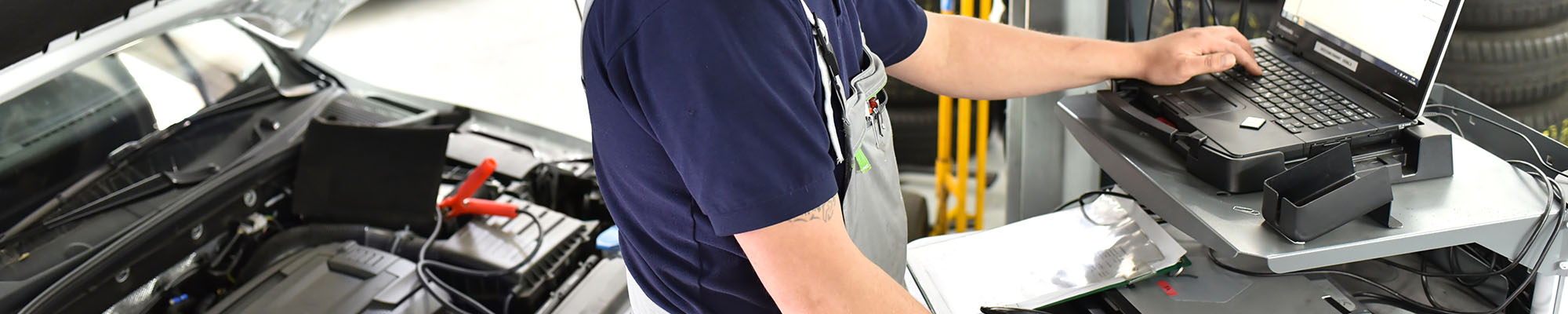
Car Diagnostics In Nottingham
A warning light on its own doesn’t tell you much. Our diagnostic checks find out what’s actually behind it, so you only pay to fix what’s wrong. We trace warning lights, poor running and electrical faults for drivers across Nottingham at our garage in Stapleford.
Finding The Fault Before Fixing Its
Modern cars rely on dozens of sensors and control units that monitor everything from fuel mixture to wheel speed. When a reading falls outside its normal range, the system stores a fault code and often lights a warning on the dashboard.
Without diagnostics, tracking down a fault can mean replacing parts in the hope that one of them solves it. A proper check narrows the problem down quickly and saves you paying for repairs you didn’t need.
Finding faults early protects the rest of the car too. A failing sensor can upset the fuel mixture for example, and over time that can damage expensive emissions components.
When To Book A Diagnostic Check
- The amber engine management light is on, or keeps coming and going.
- An ABS, airbag, glow plug or traction control light stays lit after starting.
- The engine feels sluggish or suddenly drops into a reduced power mode.
- The engine shakes at idle or stumbles when you accelerate.
- The car is slow to start or cuts out shortly afterwards.
- You’re filling up more often, with no change in how you drive.
- Windows, central locking, lights or gauges are behaving erratically.
Code Readers Vs Full Diagnostics
A basic code reader will show you a fault code, but the code describes a symptom rather than its cause. A lean mixture code, for instance, could come from an air leak, a faulty sensor or a weak fuel pump, and only further testing will tell you which.
How We Diagnose Your Car
- We talk through the symptoms with you, including when they happen and any warning lights you’ve seen.
- We connect our diagnostic equipment to your car’s OBD port, usually found beneath the dashboard.
- We retrieve stored and pending fault codes, along with freeze frame data showing the conditions when each fault occurred.
- With the engine running, we monitor live sensor readings to see which components are working outside their normal range.
- We inspect and test the wiring, connectors, hoses and components linked to the fault.
- We explain what we’ve found and what’s needed to fix it before any repair work begins.
What Diagnostics Can Find
Every petrol car sold in the UK since 2001, and every diesel since 2004, has an on board diagnostics system. Newer cars monitor far more systems than early ones, giving a detailed picture of how the car is running.
Engine & Emissions Faults
Diagnostics can identify misfires, faulty sensors, fuelling problems and issues with emissions equipment such as the EGR valve. These faults often affect performance and economy long before they cause a breakdown.
Electrical & Sensor Faults
Your car’s control units share information over a network of wiring known as the CAN bus. A diagnostic check can reveal communication errors, failing sensors and wiring problems that would be very hard to trace by eye.
Safety Systems
ABS, airbag and stability control systems store their own fault codes, separately from the engine. A warning light for any of them means the system may not work when you need it, so it’s worth investigating promptly.
What Affects The Cost Of A Diagnostic Check?
The nature of the fault makes the biggest difference. Some problems show up straight away, whilst intermittent and electrical faults usually take longer to trace because they may only appear under certain conditions.
Some cars also need manufacturer specific software or extra testing to reach every system. The diagnostic check is priced separately from the repair, which is quoted once the cause has been confirmed.
Frequently Asked Questions
-
Can I keep driving with the engine management light on?
If the light is steady and the car drives normally, you can usually carry on carefully, but book a diagnostic check soon. If the light is flashing, stop as soon as it’s safe to do so. A flashing light often signals a severe misfire, which can damage the catalytic converter.
-
Will clearing the fault code fix the problem?
No. Clearing a code only switches off the warning light. If the underlying fault is still there, the code and the light will come back.
-
Why did my warning light go off on its own?
Some faults are intermittent, so the light switches off once the system stops detecting the problem. The fault code is usually still stored in the memory, which is why a diagnostic check can still find it.
-
What is limp mode?
Limp mode is a protective setting in which the engine control unit limits power and revs to prevent further damage. It’s designed to get you home or to a garage, not for continued everyday driving.
-
Can diagnostics find intermittent faults?
Often, yes. Freeze frame data records the engine speed, temperature and load at the moment the fault occurred, and a road test whilst monitoring live data can help catch a fault that only appears under certain conditions.
-
Is a diagnostic check worth doing before buying a used car?
Yes, as it can reveal stored faults the seller may not have mentioned. It can also show whether codes have been cleared recently, which may suggest a problem has been hidden rather than fixed.
Book A Diagnostic Check
When a warning light comes on, or your car just doesn’t feel right, an early diagnostic check can stop a small fault turning into an expensive one.
Call us on 07546 162 088 or book online, and we’ll get to the bottom of it.